Bitcoin has a feature that makes its supply system very different from traditional currencies: the rate at which new bitcoins enter circulation is programmed to decline over time. This reduction occurs through an event known as the Bitcoin halving.
A Bitcoin halving happens approximately once every four years, or more precisely every 210,000 blocks. During a halving, the block subsidy received by Bitcoin miners is reduced by 50%. The most recent halving occurred on 20 April 2024, reducing the block subsidy from 6.25 BTC to 3.125 BTC per block.
The next Bitcoin halving is expected around 2028, when the subsidy is scheduled to decline again to 1.5625 BTC per block. The exact calendar date cannot be known far in advance because the event is determined by block height rather than a fixed date.
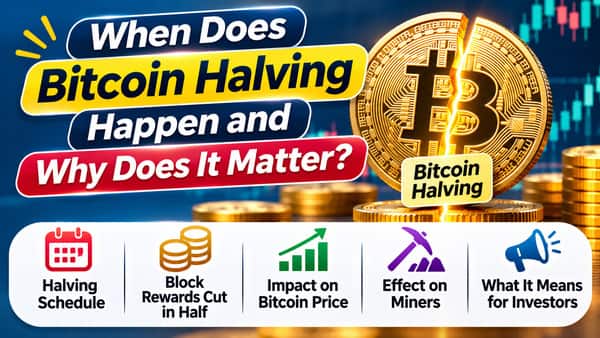
Halving matters because it controls Bitcoin’s new supply, affects miner economics and has historically attracted significant investor attention.
What Is Bitcoin Halving?
Bitcoin miners use computing power to secure the network, verify valid transactions and compete to add new blocks to the blockchain.
When a miner successfully produces a block, the miner can receive revenue from two main sources:
- The block subsidy, consisting of newly created BTC
- Transaction fees paid by users
Bitcoin’s protocol does not keep the block subsidy constant.
After every 210,000 blocks, the subsidy is cut in half. This process is known as the Bitcoin halving.
The mechanism gradually slows the creation of new bitcoins until the maximum supply approaches 21 million BTC.
Halving therefore does not cut the Bitcoin already held by investors. If you own 1 BTC before a halving, you still own 1 BTC afterward.
It is the new issuance paid through the block subsidy that is reduced.
When Do Bitcoin Halvings Happen?
Bitcoin aims to produce a new block approximately every 10 minutes on average. At that pace, reaching another 210,000 blocks takes roughly four years.
The major Bitcoin halvings so far have been:
2009 – Bitcoin launches: 50 BTC per block
2012 – First halving: 25 BTC
2016 – Second halving: 12.5 BTC
2020 – Third halving: 6.25 BTC
2024 – Fourth halving: 3.125 BTC
Expected 2028 – Fifth halving: 1.5625 BTC
This process is expected to continue for many decades.
Because actual block production varies around the 10-minute target, predictions for future halving dates can shift. The reliable trigger is the relevant block height, not a predetermined calendar date.
Why Does Bitcoin Halving Happen?
Halving is part of Bitcoin’s monetary policy.
Unlike a conventional currency, Bitcoin does not have a central bank deciding how many new units should be issued each year.
Instead, Bitcoin’s issuance schedule is encoded into its consensus rules.
Halving serves several purposes.
It Reduces New Bitcoin Supply
Before the 2024 halving, miners could receive 6.25 newly created BTC as the subsidy for a block.
After the halving, that amount became 3.125 BTC.
Assuming similar block production, the amount of new BTC entering circulation through block subsidies was therefore cut roughly in half.
It Creates Predictable Scarcity
Bitcoin’s issuance schedule can be estimated years in advance.
Investors know that the rate of new supply will continue declining over time unless the network’s consensus rules are fundamentally changed.
It Supports the 21 Million Supply Limit
Bitcoin’s maximum supply is designed to approach 21 million coins.
Repeated halvings cause new issuance to become progressively smaller, allowing Bitcoin to approach that limit gradually rather than issuing all coins immediately.
Does Bitcoin Halving Reduce Your Bitcoin Balance?
No.
This is a common misunderstanding among beginners.
Suppose you own 0.5 BTC before the halving. You will still have 0.5 BTC after it.
The halving does not:
- Cut wallet balances in half
- Remove existing Bitcoin
- Double the number of coins you own
- Automatically double Bitcoin’s price
The event specifically reduces the block subsidy available to miners.
Existing Bitcoin ownership is unaffected.
Why Does Bitcoin Halving Matter to Investors?
Halving receives substantial investor attention because it changes the relationship between Bitcoin’s existing supply and newly issued supply.
If demand for Bitcoin remained unchanged while the amount of new BTC entering circulation declined, basic supply-and-demand reasoning suggests that reduced new supply could support price scarcity.
However, markets are considerably more complicated.
Bitcoin’s price is also affected by:
- Investor demand
- Institutional participation
- Global liquidity
- Interest rates
- Regulation
- Market sentiment
- Macroeconomic conditions
- Leverage and speculation
Therefore, halving is only one factor influencing Bitcoin’s price.
Does Bitcoin Always Rise After a Halving?
Bitcoin has historically experienced major bull markets around previous halving cycles, which is why the event attracts so much attention.
However, past performance does not establish a rule that Bitcoin must rise after every future halving.
Investors should also be careful when interpreting historical data because Bitcoin has experienced only a small number of halvings.
Each cycle occurred under different conditions involving adoption, regulation, liquidity and the broader global economy.
The market may also anticipate a halving months before it happens. Since the event is predictable, investors can buy or sell based on expectations well before the actual block is mined.
A halving should therefore not be treated as an automatic buy signal.
What Happens to Bitcoin Miners After a Halving?
Miners experience the most direct economic effect.
Imagine a miner receiving a certain share of Bitcoin block subsidies before a halving. Immediately afterward, the subsidy associated with each block is 50% lower.
If Bitcoin’s price, transaction-fee revenue and other conditions remain unchanged, mining revenue from the block subsidy declines.
This can put pressure on miners with:
- Expensive electricity
- Older ASIC machines
- Poor energy efficiency
- High hosting costs
- Large debt obligations
- High operating expenses
More efficient mining businesses may be better positioned to survive periods of lower mining revenue.
Can Bitcoin Mining Become Unprofitable After a Halving?
Yes, particularly for inefficient miners.
Mining profitability depends on more than the number of BTC awarded per block.
Important variables include:
- Bitcoin’s market price
- Electricity cost
- ASIC efficiency
- Network difficulty
- Total network hash rate
- Transaction fees
- Mining pool charges
- Cooling and infrastructure expenses
After a halving, some older machines may no longer generate enough revenue to justify their electricity costs.
Miners may then shut down inefficient equipment until economic conditions improve.
What Happens When All 21 Million Bitcoins Are Mined?
Bitcoin is expected to approach its maximum supply around 2140, although the exact timing depends on block production.
As repeated halvings continue, the block subsidy will become progressively smaller.
Eventually, newly issued BTC from the subsidy is expected to effectively reach zero.
At that stage, miners would no longer rely on newly created bitcoins as a block subsidy. Instead, the system is designed for transaction fees to become the primary source of miner revenue.
How the Bitcoin fee market develops over such a long period remains an important subject of discussion because network conditions can change significantly over more than a century.
Does Halving Make Bitcoin More Valuable?
Halving makes new Bitcoin issuance scarcer, but scarcity alone does not guarantee value.
An asset also requires demand.
Imagine a product whose production is cut in half but nobody wants to buy it. Reduced production alone would not necessarily make it valuable.
Bitcoin’s market price therefore depends on the interaction between limited supply and investor demand.
The halving strengthens Bitcoin’s scarcity mechanism, while the market ultimately determines what investors are willing to pay.
Should You Buy Bitcoin Before a Halving?
Buying Bitcoin purely because a halving is approaching can be risky.
Since halvings are predictable, professional and retail investors can position themselves long before the event occurs. Some expectations may therefore already be reflected in market prices.
Instead of relying only on the halving, investors should consider:
- Their investment horizon
- Current Bitcoin allocation
- Risk tolerance
- Overall financial position
- Market valuation
- Reasons for owning Bitcoin
- Ability to tolerate major price declines
Bitcoin can experience substantial corrections even during periods when long-term investor sentiment is positive.
The halving is an important part of Bitcoin’s economics, but it should not be treated as a guaranteed profit event.
FAQs
Q1. When is the next Bitcoin halving?
A. The next Bitcoin halving is expected around 2028, when the block subsidy is scheduled to fall from 3.125 BTC to 1.5625 BTC. The exact date will depend on when the Bitcoin blockchain reaches the required block height.
Q2. Does Bitcoin’s price double after halving?
A. No. The block subsidy is reduced by 50%, but Bitcoin’s market price does not automatically double. Price depends on supply, demand, investor sentiment, liquidity, economic conditions and many other factors.
Q3. Will my Bitcoin be cut in half during a halving?
A. No. Your Bitcoin balance does not change. If you own 1 BTC before the halving, you still own 1 BTC afterward. Only the subsidy for mining new blocks is reduced.
Q4. How many Bitcoin halvings are left?
A. Halvings are expected to continue roughly every four years until the block subsidy becomes negligible and Bitcoin approaches its maximum supply of 21 million BTC, expected around the year 2140. This means many more halving events remain before new Bitcoin issuance effectively ends.