Transaction fees can make a major difference when cryptocurrency is used for frequent transfers. Sending Bitcoin or interacting with a busy smart-contract network can sometimes cost considerably more than transferring assets through blockchains specifically designed for inexpensive transactions.
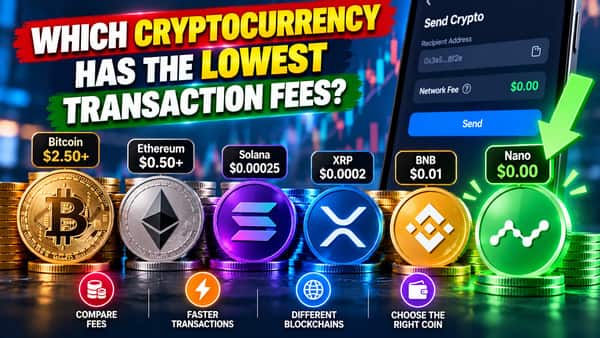
Several cryptocurrencies are known for extremely low network fees. Nano (XNO) is unusual because its protocol supports feeless transactions, while networks such as Stellar (XLM), XRP Ledger (XRP) and Solana (SOL) generally process ordinary transactions for very small fees.
However, there is no single cryptocurrency that is always the cheapest in every situation. Fees depend on the blockchain, type of transaction, network conditions and whether you are transferring from your own wallet or withdrawing through an exchange.
Why Do Cryptocurrencies Charge Transaction Fees?
Blockchain networks need mechanisms to process transactions while protecting the system from abuse.
Depending on the blockchain, transaction fees can help:
- Discourage network spam
- Prioritize transactions
- Compensate validators
- Allocate limited network resources
- Support network security
Different cryptocurrencies solve these problems differently.
Bitcoin uses a fee market in which users compete for block space. Other networks are designed to process much larger numbers of transactions at extremely low individual costs.
This is why sending the same economic value through different blockchain networks can result in very different fees.
Nano (XNO): Cryptocurrency With No Transaction Fee
Nano stands out because ordinary transactions are feeless at the protocol level.
Unlike many blockchains, Nano does not require users to pay miners or validators every time they transfer XNO.
Its architecture uses individual account chains and a consensus system called Open Representative Voting.
This makes Nano particularly suitable for situations involving small payments because the recipient can receive the transferred amount without a network transaction fee being deducted in the conventional way.
For example, if you want to transfer a very small amount, a large blockchain fee could make the payment impractical. A feeless structure avoids that problem.
However, low fees alone should not determine whether a cryptocurrency is a suitable investment.
Investors should separately consider liquidity, adoption, network security, exchange availability and long-term demand.
Stellar (XLM): Extremely Low Fees for Payments
Stellar was designed with payments and asset transfers as major use cases.
Its minimum fee for a standard operation can be just 0.00001 XLM, although fees can increase under surge-pricing conditions when the network is busy.
This makes ordinary Stellar transfers extremely inexpensive.
The network is particularly suited to areas such as:
- Cross-border transfers
- Digital payments
- Asset transfers
- Remittances
- Small-value transactions
Stellar also supports more complicated blockchain functionality, where fees may work differently from a simple XLM payment.
For ordinary transfers, however, the cost is generally tiny compared with many older blockchain networks.
XRP: Very Low Transaction Costs
The XRP Ledger is another network known for inexpensive transactions.
A standard transaction currently has a minimum network cost of 10 drops, where one drop equals one-millionth of an XRP.
Therefore:
10 drops = 0.00001 XRP
The actual required cost can increase when network load rises, and certain specialized transactions require higher amounts.
Unlike a conventional fee paid directly to a miner, the XRP used for the transaction cost is destroyed.
This mechanism helps discourage spam and protects the network from excessive activity.
For ordinary XRP transfers, the cost is normally extremely small.
Solana (SOL): Low Fees With Smart-Contract Capability
Solana is another blockchain well known for inexpensive transactions.
Its standard base fee is currently 5,000 lamports per signature.
Since:
1 SOL = 1 billion lamports
5,000 lamports equals:
0.000005 SOL
Users can also pay optional priority fees when they want transactions prioritized.
Solana is particularly notable because low fees apply within a much broader smart-contract ecosystem.
The network supports:
- Token transfers
- Decentralized exchanges
- DeFi applications
- NFTs
- Blockchain games
- Payment applications
More complicated interactions can involve additional costs, and certain actions may require account creation or additional blockchain resources.
Therefore, the cost of simply sending SOL should not be assumed to equal the total cost of every activity performed on Solana.
What About Litecoin?
Litecoin (LTC) has historically been used as a lower-cost alternative for cryptocurrency transfers.
Its transaction fees are generally much lower than Bitcoin fees, although actual costs depend on transaction size and network conditions.
Litecoin can be useful for straightforward value transfers because it has:
- A long operating history
- Broad exchange availability
- Relatively inexpensive transfers
- Faster block generation than Bitcoin
However, newer networks such as Stellar, XRP Ledger and Solana can offer extremely small transaction costs.
The cheapest option therefore depends on which networks both the sender and receiver support.
Why Can Bitcoin Transaction Fees Be Higher?
Bitcoin prioritizes decentralization, security and a conservative approach to block-space capacity rather than attempting to make every transaction nearly free.
Bitcoin blocks have limited capacity.
When many users want their transactions confirmed, they compete for available block space by offering transaction fees.
During periods of heavy demand, users willing to pay higher fees may receive faster confirmation.
This can make Bitcoin less suitable for very small on-chain payments during periods when fees are elevated.
However, Bitcoin also has the Lightning Network, which is designed to support faster and lower-cost Bitcoin payments outside the main blockchain while ultimately using Bitcoin as the underlying asset.
Comparing Lightning payments directly with ordinary on-chain transactions therefore requires understanding that they operate differently.
What About Ethereum Transaction Fees?
Ethereum fees work differently from simple payment-focused networks.
Users pay gas for blockchain computation.
A simple ETH transfer uses relatively little gas, while a complicated smart-contract interaction can consume substantially more.
For example, activities such as:
- Token swaps
- DeFi transactions
- NFT operations
- Complex smart contracts
can require more gas than simply sending ETH.
Ethereum has also developed an ecosystem of Layer 2 networks designed to process transactions more efficiently while connecting back to Ethereum.
Therefore, comparing Ethereum only through main-network transaction fees can overlook the increasingly important role of Layer 2 scaling.
Which Cryptocurrency Is Cheapest for Sending Money?
For straightforward transfers, several networks stand out.
Nano (XNO): Protocol-level feeless transactions.
Stellar (XLM): Extremely small minimum fees for standard operations.
XRP: Standard transactions generally require only a tiny amount of XRP.
Solana (SOL): Very low base transaction fees while supporting a large smart-contract ecosystem.
Litecoin (LTC): Generally inexpensive for straightforward crypto transfers compared with Bitcoin’s base layer.
There is no need to choose only according to the smallest theoretical fee.
A difference between a fraction of a cent and another fraction of a cent may be practically irrelevant compared with factors such as exchange support, liquidity and security.
Network Fee and Exchange Withdrawal Fee Are Different
This is one of the most important points for beginners.
Suppose sending a cryptocurrency directly from one personal wallet to another costs only a tiny network fee.
Your exchange might still charge a much larger withdrawal fee.
These are different costs.
Network Fee
The cost associated with processing a transaction through the blockchain.
Exchange Withdrawal Fee
An amount determined by the cryptocurrency exchange when you withdraw assets from the platform.
The exchange may charge more than the blockchain’s minimum network cost.
Therefore, a cryptocurrency advertised as having extremely low transaction fees may still be relatively expensive to withdraw from a particular exchange.
Always check the exchange’s current withdrawal screen before confirming the transaction.
Does the Cheapest Network Always Make the Best Choice?
No.
Choosing a cryptocurrency solely because its fee is low ignores several other important factors.
Before transferring significant value, consider:
- Network security
- Liquidity
- Exchange availability
- Wallet support
- Transaction finality
- Reliability
- Decentralization
- Receiving platform support
Saving a few rupees on fees is not useful if you accidentally choose a network that the receiving platform does not support.
The cheapest transaction is not necessarily the safest or most convenient transaction.
Be Careful When Choosing a Transfer Network
Some crypto assets can exist on multiple blockchain networks.
An exchange may allow withdrawals using several networks with different fees.
The cheapest network should only be selected if the receiving wallet or exchange explicitly supports that network for the asset you are sending.
Before transferring cryptocurrency:
- Check the receiving address.
- Verify the cryptocurrency.
- Verify the blockchain network.
- Check the withdrawal fee.
- Check whether a memo or destination tag is required.
- Consider a small test transfer for a large amount.
Selecting the wrong network can result in funds not being automatically credited and, in some situations, can make recovery difficult or impossible.
Which Low-Fee Cryptocurrency Is Best?
There is no universal winner because different cryptocurrencies serve different purposes.
For pure protocol-level transfer costs, Nano is notable for feeless transactions.
For low-cost payment-oriented transfers, Stellar and XRP Ledger are strong examples of networks with extremely small fees.
For users who also want access to smart contracts and decentralized applications, Solana combines very low base fees with a larger programmable blockchain ecosystem.
Investors should also distinguish between selecting a blockchain for transferring money and selecting a cryptocurrency as an investment.
A coin having the lowest transaction fee does not mean it has the highest investment potential.
FAQs
Q1. Which cryptocurrency has zero transaction fees?
A. Nano (XNO) is designed to support feeless transactions at the protocol level. However, cryptocurrency exchanges may still impose their own withdrawal or service charges when transferring Nano from their platforms.
Q2. Is XRP cheaper to send than Bitcoin?
A. Ordinary transactions on the XRP Ledger generally have very small network fees, while Bitcoin on-chain transaction fees can become considerably higher when demand for block space increases. Exchange withdrawal charges are separate and should be checked before making a transfer.
Q3. Is Solana cheap for transferring cryptocurrency?
A. Yes. Solana is generally considered a low-fee blockchain. Its base transaction fee is typically 5,000 lamports per signature, equivalent to 0.000005 SOL. Priority fees and more complex blockchain activities can increase the total cost.
Q4. Why does my exchange charge more than the cryptocurrency’s network fee?
A. An exchange withdrawal fee is determined by the exchange and does not necessarily equal the blockchain’s network fee. Exchanges may set fixed or variable withdrawal charges that account for operational costs, network conditions, transaction processing, and their own fee policies.