Understanding how a Demat account works is one of the most important foundational steps for any new investor entering India’s capital markets. Millions of people open Demat accounts every year — but a surprising number do so without fully understanding the mechanics behind what happens when they buy a share, receive a dividend, or sell a security. This gap in understanding can lead to confusion about charges, delays, and the sequence of events in every transaction. This article explains, step by step and in complete detail, exactly how a Demat account works in practice — from the infrastructure that powers it to the transaction-level mechanics every investor experiences daily.

The Infrastructure Behind a Demat Account
A Demat account does not exist as a standalone digital file on your broker’s server. It is part of a sophisticated, multi-tier national infrastructure that involves regulators, central depositories, depository participants, and investors — all working in a coordinated sequence.
| Level | Entity | Role |
| Regulator | SEBI (Securities and Exchange Board of India) | Sets rules, monitors compliance, protects investors |
| Central Depository 1 | NSDL (National Securities Depository Limited) | Master record-keeper for securities held by NSDL DPs |
| Central Depository 2 | CDSL (Central Depository Services Limited) | Master record-keeper for securities held by CDSL DPs |
| Depository Participant | Your broker or bank | Opens your account; your daily interface |
| Investor | You | Account holder — owns and manages holdings |
| Stock Exchange | NSE / BSE | Executes trades — communicates with depositories for settlement |
| Clearing Corporation | NSE Clearing / BSE Clearing | Settles trade obligations between buyers and sellers |
When you buy shares, the entire chain from stock exchange to clearing corporation to depository to Demat account is activated — working silently in the background to ensure your securities are correctly credited within T+1.
How a Demat Account Works: Step-by-Step Transaction Flow
Buying Shares — The Credit Process
Step 1 — You Place a Buy Order: Through your Trading account (linked to your Demat account), you place a buy order for, say, 100 shares of Company X at ₹500 per share. Total value: ₹50,000.
Step 2 — Order Executed on the Exchange: Your Trading account communicates the order to NSE or BSE. When a matching sell order is found at your price, the trade is executed. You receive a trade confirmation.
Step 3 — Clearing Corporation Processes the Trade: NSE Clearing or BSE Clearing confirms the trade, determines obligations (you owe ₹50,000; the seller owes 100 shares), and instructs the depositories accordingly.
Step 4 — Money Debited from Your Bank Account: On trade day (T), ₹50,000 is debited from your linked bank account (or deducted from your available trading margin).
Step 5 — Shares Credited to Your Demat Account on T+1: By the next working day (T+1), 100 shares of Company X appear as a credit in your Demat account — visible in your portfolio immediately.
Selling Shares — The Debit Process
Step 1 — You Place a Sell Order: Through your Trading account, you place a sell order for your 100 shares of Company X at ₹600 per share.
Step 2 — Trade Executed on Exchange: The matching buy order is found and the trade is executed. You receive a trade confirmation.
Step 3 — Debit Instruction Issued: A debit instruction is automatically generated — informing your Demat account that 100 shares of Company X must be delivered to the buyer’s Demat account.
Step 4 — Shares Debited from Your Demat Account on T+1: On T+1, 100 shares are removed from your Demat account — delivered electronically to the buyer’s Demat account via the clearing corporation.
Step 5 — Money Credited to Your Bank Account: ₹60,000 (minus applicable brokerage and taxes) is credited to your linked bank account on T+1.
How Corporate Actions Work in a Demat Account
One of the most powerful operational features of a Demat account is the automatic processing of corporate actions — no manual intervention required from the investor.
| Corporate Action | How It Works in Demat |
| Dividend | Company transfers dividend to registrar → registrar credits your linked bank account directly on payment date |
| Bonus Shares | Company announces bonus ratio → shares auto-credited to your Demat on record date |
| Stock Split | Company changes face value → your share quantity adjusted automatically on record date |
| Rights Issue | Rights entitlement credited to your Demat → you choose to subscribe, renounce, or sell rights |
| Merger / Acquisition | Old company shares debited → new merged entity’s shares credited as per exchange ratio |
| Delisting | Shares remain in Demat — can be tendered during delisting offer process |
How Dematerialisation and Rematerialisation Work
For investors who still hold old physical share certificates from the pre-1996 era, Dematerialisation is the process of converting them into electronic form in your Demat account. You submit the physical certificates along with a Dematerialisation Request Form (DRF) to your DP — who coordinates with the company’s registrar to verify and convert them into electronic holdings, typically within 15 to 30 days.
The reverse process — Rematerialisation — converts electronic holdings back into physical certificates. This is extremely rare in 2026 and practically unnecessary, but the facility exists for specific legal or personal requirements.
How the Pledge Facility Works
When you need funds but do not want to sell your investments, the pledge facility allows you to use your Demat holdings as collateral. You submit a pledge instruction through your DP → the pledgee (bank or broker) accepts the pledge electronically → your shares are marked as pledged in your Demat account but remain in your name → you receive the loan or margin accordingly.
When the loan is repaid, a unpledge instruction is issued → shares are released from pledge status → your holdings revert to fully free status.
How the Demat Account Number Works
Your Demat account is identified by a unique number composed of two components:
| Component | Description | Example |
| DP ID | 8-digit identifier of your Depository Participant | 12345678 |
| Client ID | 8-digit personal identifier assigned to you | 87654321 |
| Full Demat Account Number | DP ID + Client ID combined | 1234567887654321 |
For CDSL accounts, the 16-digit combined number is used as the full account number. For NSDL accounts, the format is slightly different — beginning with “IN” followed by the DP ID and Client ID. This unique number is what you provide when applying for IPOs, transferring securities, or linking accounts.
Frequently Asked Questions (FAQs)
Q1. How quickly do shares appear in my Demat account after purchase? Under SEBI’s T+1 settlement cycle, shares are credited to your Demat account by the next working day after your purchase is executed on the exchange.
Q2. Do I need to do anything when I receive a dividend? No. Dividends are credited directly to your linked bank account by the company’s registrar on the payment date — fully automatic, with no manual action required.
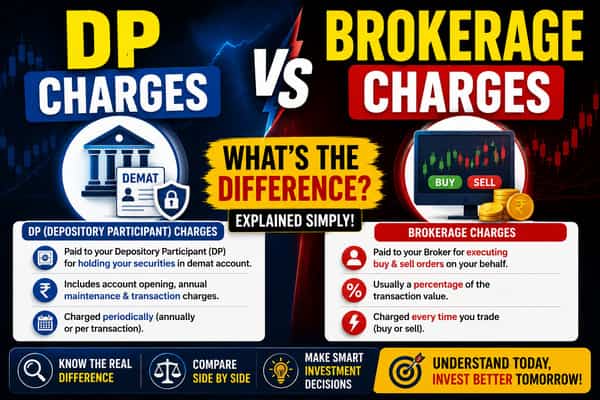
Q3. What is a DP charge and when is it levied? A DP (Depository Participant) charge is a flat transaction fee levied when shares are debited from your Demat account — i.e., when you sell. It is not charged when shares are credited (when you buy).
Q4. Can shares be transferred from one Demat account to another without selling? Yes. Shares can be transferred electronically between Demat accounts using the CDSL Easiest / NSDL Speed-e facility — useful when switching brokers or gifting shares to family members.
Q5. What happens to my Demat account if my broker shuts down? Your securities are safe. They are held by NSDL or CDSL — not by your broker. If a broker closes, you simply transfer your holdings to another DP. Your securities cannot be taken by the broker.