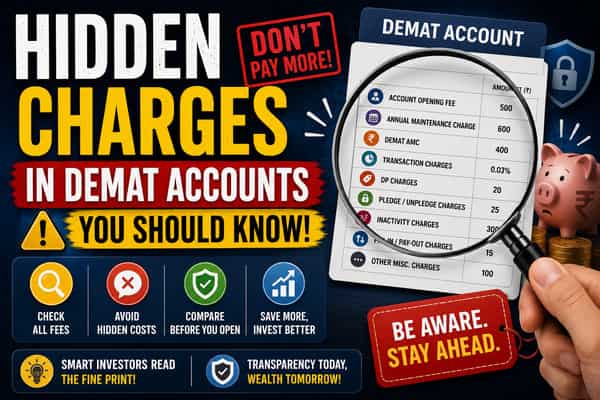
The headline pricing of a Demat account — zero account opening fee, zero delivery brokerage, flat ₹20 intraday brokerage — is what attracts investors to most brokers in India. But the full cost picture of a Demat account is significantly more complex than the headline suggests. India’s Demat account landscape has numerous charges that are either not prominently disclosed, poorly understood by investors, or buried deep within account agreement documents that most people never read. These charges — which some investors describe as “hidden” — are not illegal or even necessarily unfair, but they are frequently undiscovered until they appear as unexpected deductions. This article exposes every significant charge that Demat account investors in India encounter — and explains precisely when each applies, how much it costs, and how to manage or minimise it.
1. DP (Depository Participant) Transaction Charges
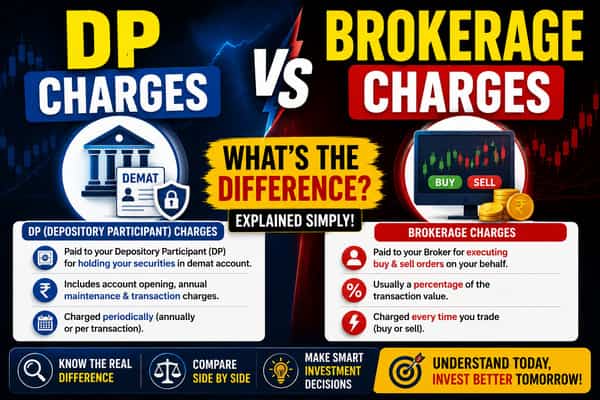
The most common hidden charge. DP charges catch more investors by surprise than any other Demat account fee — because they are not brokerage, they are not mentioned alongside brokerage on most broker’s marketing material, and they apply every time you sell shares — regardless of trade size, value, or profit.
A DP charge is a flat fee levied each time shares are debited from your Demat account. It compensates your DP for issuing the debit instruction to NSDL or CDSL.
| Broker | DP Charge Per Sell | With 18% GST |
| Zerodha | ₹13.50 | ₹15.93 |
| Groww | ₹14.00 | ₹16.52 |
| Upstox | ₹18.50 | ₹21.83 |
| Angel One | ₹15.00 | ₹17.70 |
| HDFC Securities | ₹25.00 | ₹29.50 |
The surprise: Selling 10 shares of a ₹150 stock (₹1,500 trade) on Zerodha — you pay ₹0 brokerage but ₹15.93 DP charge — meaning DP charges actually exceed brokerage on small trades.
How to manage it: Consolidate sell transactions — sell larger quantities in fewer transactions rather than small quantities across multiple transactions. One sell instruction for 100 shares costs the same DP charge as one for 10 shares.
2. AMC After the “Free First Year”
Many investors open accounts with Groww, Upstox, or Angel One attracted by zero AMC for the first year — and are then surprised when a deduction appears in their trading account in the 13th month.
The reality: Free-first-year AMC is a promotional incentive — not a permanent feature. From the second year, standard AMC of ₹150 to ₹300 applies at most discount brokers. Always check the broker’s charge schedule for year-2 AMC before opening an account.
3. GST on All Service Charges
GST at 18% is levied on every broker-charged service component — including brokerage, DP charges, account maintenance charges, and exchange transaction fees. Most investors see the headline brokerage (₹20) but forget that the actual deduction is ₹23.60 (₹20 + ₹3.60 GST).
Across a year of active trading:
| Monthly Trades | Annual Brokerage | Annual GST (18%) | Total Annual Cost |
| 20 intraday trades/month | ₹4,800 | ₹864 | ₹5,664 |
| 50 intraday trades/month | ₹12,000 | ₹2,160 | ₹14,160 |
GST is a statutory government charge — it cannot be avoided or reduced regardless of broker choice.
4. Securities Transaction Tax (STT) on Delivery Buys
Most investors know they pay STT on delivery sales (0.1%). Many forget — or never knew — that STT is also charged on delivery purchases at 0.1%. This means a ₹1,00,000 equity delivery buy attracts ₹100 STT in addition to all other charges, even though no sale has occurred.
| Transaction | STT Rate | On ₹50,000 Trade |
| Delivery Buy | 0.1% | ₹50 |
| Delivery Sell | 0.1% | ₹50 |
| Intraday Sell Only | 0.025% | ₹12.50 |
5. Stamp Duty on Every Buy Transaction
Stamp duty — standardised nationally since 2020 — is charged on every securities purchase. Many investors are unaware of this charge because it is small and appears as a line item on trade confirmation emails that most investors do not read carefully.
| Transaction | Stamp Duty Rate | On ₹1,00,000 Buy |
| Equity Delivery Buy | 0.015% | ₹15 |
| Equity Intraday Buy | 0.003% | ₹3 |
| F&O Buy | 0.002% | ₹2 |
| Mutual Fund Buy | 0.005% | ₹5 |
6. Physical Statement and Document Charges
Most investors rely on digital statements — but those who request physical copies of holding statements, transaction summaries, or other account documents may be charged by their broker.
| Service | Typical Charge |
| Physical Statement Request | ₹25 to ₹100 per request |
| Duplicate Account Details | ₹25 to ₹50 |
| Physical Welcome Kit | Sometimes included, sometimes ₹50 to ₹100 |
Tip: Always use your broker’s app or email-delivered digital statements — they are free and available instantly.
7. Failed Payment / ECS Rejection Charges
When a SIP auto-debit or AMC deduction fails because of insufficient funds in the linked bank account, most brokers charge a failed transaction penalty — on top of any bank ECS dishonour charges.
| Charge | Range |
| Failed SIP ECS charge (broker side) | ₹25 to ₹100 per failure |
| Bank dishonour charge | ₹250 to ₹500 (bank-dependent) |
8. Call and Trade Charges
Investors who place orders through a broker’s customer care number — instead of through the self-service app or website — are charged a “Call and Trade” fee per order.
| Broker | Call and Trade Charge |
| Zerodha | ₹50 per order |
| Upstox | ₹20 per order |
| Angel One | ₹20 per order |
Tip: Always use the app or web platform for order placement — call and trade is significantly more expensive and should be used only for emergencies.
9. Pledge and Unpledge Charges
Many investors who use margin trading by pledging their holdings are surprised to find pledge charges on their account statement.
| Broker | Pledge Charge | Unpledge Charge |
| Zerodha | ₹30 per request | ₹0 |
| Groww | ₹20 per request | ₹0 |
| Upstox | ₹20 per request | ₹0 |
10. Account Dormancy Reactivation Charge
A Demat account that has had no transactions for an extended period — typically 12 to 24 months — is marked dormant by the DP. Reactivating it requires submission of fresh KYC and may attract a dormancy reactivation fee.
| Charge | Range |
| Dormancy Reactivation Fee | ₹50 to ₹500 (broker-dependent) |
Complete Hidden Charges Summary
| Charge | Amount | When Charged |
| DP Transaction Charge | ₹13.50 to ₹25 + GST | Every sell transaction |
| Year-2 AMC | ₹150 to ₹750/year | From second year onward |
| GST on Services | 18% on brokerage + exchange charges | Every trade |
| STT on Delivery Buy | 0.1% of buy value | Every delivery purchase |
| Stamp Duty | 0.003% to 0.015% | Every buy transaction |
| Physical Statement | ₹25 to ₹100 | When requested |
| Failed Payment | ₹25 to ₹500 | On ECS failure |
| Call and Trade | ₹20 to ₹50 | Per phone-placed order |
| Pledge Charge | ₹20 to ₹30 | Per pledge request |
| Dormancy Reactivation | ₹50 to ₹500 | On dormant account reactivation |
Frequently Asked Questions (FAQs)
Q1. Why was I charged ₹15 on a zero-brokerage trade?
That ₹15 is a DP charge — levied every time shares leave your Demat account when you sell. Zero brokerage means zero broker commission, but DP charges, STT, exchange charges, and GST still apply on every sell transaction.
Q2. How can I see all charges on my Demat account?
Every trade generates a Contract Note — a detailed document showing every charge component. Request and read your daily contract note through your broker’s app or email. Your broker is legally required to provide this.
Q3. Are these “hidden” charges illegal?
No — all charges are disclosed in the account opening agreement and charge schedule, which every investor electronically signs. They are “hidden” only in the sense that they are not prominently featured in broker marketing materials.
Q4. Which broker has the most transparent charge disclosure?
Zerodha is widely acknowledged as the most transparent broker in India regarding charges — its website clearly lists every charge including DP fees, STT, exchange charges, and GST with precise calculations and examples.
Q5. How can I minimise total Demat account charges?
Choose a zero-AMC discount broker, consolidate sell transactions to reduce DP charge frequency, use the app for all orders (avoid call and trade), maintain sufficient bank balance for auto-debits, and invest in long-term delivery positions rather than high-frequency intraday trading.