You are standing on a busy road when two drivers begin arguing after an accident. Several people pull out their phones and start recording. A few metres away, someone is filming a travel vlog, and dozens of strangers appear in the background. In another situation, however, a person deliberately follows one particular woman through a market and repeatedly films her despite her objections.
All three situations involve recording people in public, but they do not necessarily have the same legal consequences.
As a general rule, India does not have a blanket law prohibiting every photograph or video of another person taken in a public place. However, being in public does not mean a person loses all rights to privacy, dignity and personal safety. The purpose of the recording, the circumstances, what exactly is being captured and what happens to the footage afterwards can change the legal position.
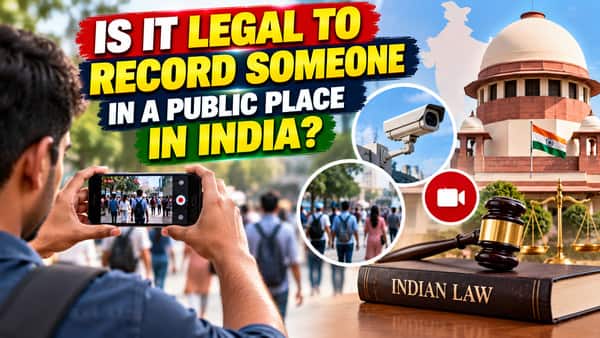
Is It Illegal to Film Someone in Public?
Ordinary photography or videography in a public place is not automatically a criminal offence merely because other people appear in the recording.
Think about everyday situations such as:
- Tourists photographing a monument;
- A family making a video at a public park;
- A journalist covering an incident;
- Someone recording a road accident;
- A motorist using a dashboard camera;
- A person recording an altercation for evidence; or
- A content creator filming a street scene.
It would be unrealistic to require express permission from every person who happens to appear in the background of every photograph or video.
The legal position becomes more complicated when the recording specifically targets an individual in circumstances involving privacy, harassment, sexual conduct or another prohibited act.
Do You Have a Right to Privacy in a Public Place?
Yes, potentially.
The Supreme Court has recognised privacy as a constitutionally protected right under Article 21. Importantly, the Court has also explained that privacy is not completely surrendered simply because an individual enters a public place.
At the same time, a person’s reasonable expectation of privacy can vary according to the circumstances.
Someone walking through a crowded railway station ordinarily cannot expect the same level of physical privacy as someone inside a changing room.
Therefore, “the person was in public” is not a universal defence for every type of recording.
The location is only one factor.
Can You Record an Accident or Fight in Public?
Generally, recording an incident occurring openly in a public place is not automatically prohibited.
A genuine recording can sometimes become important evidence in disputes involving:
- Road accidents;
- Assaults;
- Threats;
- Public disturbances;
- Property damage;
- Harassment; or
- Other unlawful conduct.
If the recording may be needed as evidence, preserve the original file. Avoid cutting, adding audio, changing timestamps or otherwise manipulating it.
There is also an important difference between giving potentially relevant footage to the police or a court and uploading an injured person’s distressing video to social media for views.
The fact that something was lawfully recorded does not automatically establish an unrestricted right to publish it.
What If a Woman Is Secretly Recorded?
Indian criminal law contains specific protections that become relevant in particular circumstances.
Section 77 of the Bharatiya Nyaya Sanhita, 2023 (BNS) deals with voyeurism. It criminalises specified conduct involving watching or capturing the image of a woman engaging in a private act in circumstances where she would ordinarily expect not to be observed.
A “private act” can include circumstances involving exposure of private parts, use of a lavatory or a sexual act not ordinarily done in public.
This means the simplistic statement “recording is legal because I was standing in a public place” can be dangerously wrong.
For example, secretly attempting to film inside a changing facility, washroom or another situation where a woman reasonably expects privacy can have serious criminal consequences.
What About Recording Someone’s Private Parts?
The Information Technology Act also contains an important protection.
Section 66E deals with violation of privacy involving intentionally or knowingly capturing, publishing or transmitting an image of the private area of a person without consent under circumstances violating that person’s privacy.
Accordingly, the legality of recording cannot be determined solely by asking whether the photographer was physically located on public property.
What the camera captures matters.
Can You Keep Following Someone and Recording Them?
Recording in a public place should not be confused with having a right to continuously pursue or intimidate another person.
If someone’s conduct develops into following, monitoring, threatening, sexually harassing or otherwise targeting another individual, provisions of criminal law dealing with that underlying behaviour may become relevant.
For example, Section 78 of the BNS deals with stalking in specified circumstances involving a man repeatedly following or contacting a woman despite a clear indication of disinterest, as well as specified monitoring of electronic communications.
Therefore, context matters enormously.
A tourist accidentally capturing someone in the background is very different from an individual persistently following a particular person with a camera.
Can You Record Police Officers in Public?
There is no general proposition that simply photographing or recording a police officer performing duties in a public setting is automatically a criminal offence.
However, recording does not give a person permission to obstruct an officer, cross a lawful security barrier, interfere with an investigation or disobey a lawful direction.
The sensible distinction is between documenting what is happening from a lawful position and physically interfering with official duties.
The circumstances of a particular incident can therefore determine whether additional laws become relevant.
Can You Film Inside a Mall, Metro Station or Restaurant?
This requires another distinction: publicly accessible does not necessarily mean unrestricted public property.
A shopping mall, restaurant, cinema, office complex or private event venue may be accessible to customers while still being privately controlled property.
The owner or operator can impose photography and videography conditions, subject to applicable law.
Certain government, transport, security-sensitive, defence or restricted locations may also have specific rules governing photography.
Therefore, before filming extensively, particularly with professional equipment, check the rules applicable to the premises.
Is Posting the Video Online Also Legal?
Recording and publishing should be treated as separate decisions.
Imagine that you record an argument in a marketplace. Keeping the footage as evidence is one thing. Uploading a clip with a false caption accusing an identifiable person of committing a crime is another.
Online publication can potentially raise separate questions involving:
- Defamation;
- Privacy;
- Harassment;
- Misrepresentation;
- Disclosure of sensitive information;
- Sexual or intimate imagery; and
- Rights of children or other vulnerable individuals.
A person should therefore consider not only “Can I record this?” but also “Do I have a lawful and responsible basis for publishing this?”
Recording in Public: Practical Legal Position
| Situation | General Position |
| Taking ordinary photos at a tourist location | Generally permissible, subject to location rules |
| Strangers incidentally appearing in the background | Generally not automatically unlawful |
| Recording a road accident or public altercation | Generally possible; footage may also have evidentiary value |
| Recording a private/intimate act without consent | Can constitute a serious offence |
| Filming someone’s private area in violation of privacy | Can attract criminal liability |
| Persistently following and targeting someone with a camera | May engage stalking, harassment or other laws depending on circumstances |
| Filming on privately controlled premises | Subject to property/venue rules |
| Publishing footage with defamatory allegations | Can create separate legal liability |
| Recording from a lawful position but obstructing police | Recording does not authorise obstruction |
The practical rule is therefore not that everything visible in public is automatically free to record and publish. Ordinary public photography is generally different from targeted surveillance, voyeurism, harassment or the recording of intimate/private conduct.
FAQs
Q1. Do I need permission before photographing a stranger in a public place?
A. Not necessarily. There is no blanket requirement to obtain individual consent from every person who happens to appear in ordinary public photography. However, the circumstances, subject matter, location, and manner of recording can create privacy or criminal-law issues.
Q2. Can someone force me to delete a photo because they appear in the background?
A. A person’s incidental appearance in an ordinary public photograph does not automatically mean that the photograph was unlawfully taken. Different considerations may apply if the image violates privacy, involves prohibited conduct, or was taken in a restricted location.
Q3. Can I record someone threatening or assaulting me in public?
A. A recording of threats, violence, or another incident may potentially serve as relevant evidence. Preserve the original file and consider providing it to the police or a lawyer rather than editing it or immediately publishing it online.
Q4. Is it legal to upload videos of strangers to Instagram or YouTube?
A. Recording footage in a public place does not automatically make every form of publication lawful. Depending on the circumstances, issues involving privacy, defamation, harassment, misleading captions, intimate imagery, or other legal restrictions may arise from how the footage is published or used.