Few sectors carry the kind of economic weight that manufacturing does. It builds supply chains, generates employment at scale, drives exports, and underpins the industries that everything else depends on — from healthcare to defence to consumer goods. In India, manufacturing’s role has only grown more strategic through 2025 and into 2026, with PLI schemes attracting over ₹2 lakh crore in investment commitments, Apple scaling iPhone production for global markets from Indian facilities, and the government targeting manufacturing’s share of GDP to rise significantly over the next decade.
Starting or operating a manufacturing business, though, is not the same as starting a service company or a digital venture. The capital requirements are different. The risks are different. The regulatory environment is heavier, the supply chain dependencies are real, and the workforce challenges are intensifying across the board. Understanding both sides clearly — what the model offers and what it demands — matters enormously before committing to it.
| Parameter | Details |
| Definition | Business that converts raw materials into finished goods through a production process |
| Industry Scope | Covers FMCG, electronics, automotive, pharma, textiles, heavy engineering, and more |
| India Policy Support | PLI schemes, Make in India, Skill India, Budget 2025 skilling initiatives |
| Key Advantage | Scalable production, tangible assets, export potential |
| Key Challenge | High capital cost, skilled labour shortage, supply chain volatility |
| Skilled Labour Gap (India) | Projected 30–32 million by 2025; widening to 47–49 million by 2027 |
| 2026 Outlook | 82% of manufacturers expect to increase production; 83% expect rising costs |
| Technology Shift | Automation, AI, digital twins, and Industry 4.0 now central to operations |
What the Manufacturing Model Involves
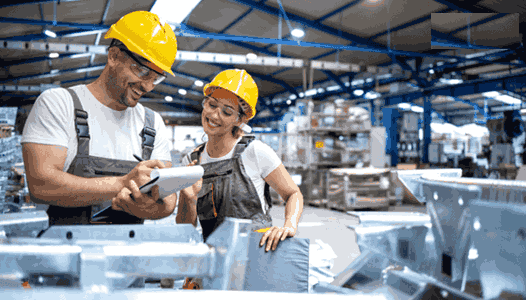
A manufacturing business purchases or procures raw materials and transforms them into finished products through a defined production process. That process can be as simple as assembling components or as complex as multi-stage chemical or pharmaceutical production. What distinguishes manufacturing from trading or services is the conversion step — value is created by making something, not just moving it or advising on it.
The model spans an enormous range — garments and packaged foods at one end, semiconductors and aerospace components at the other. What they share is the fundamental structure: input procurement, production operations, quality control, inventory management, and distribution. Each step carries its own cost structure, risk profile, and operational demands.
Advantages of a Manufacturing Business
1. Scalable Revenue and Profit Potential
Manufacturing businesses that build efficient production operations can scale output without proportionally scaling costs. Once fixed infrastructure — factory, equipment, workforce — is in place, increasing production volume drives down per-unit cost. That margin expansion at scale is one of manufacturing’s defining financial characteristics. Businesses that reach operational efficiency in manufacturing can generate strong, consistent revenues across multiple industries and markets.
2. Tangible Asset Base
Unlike service businesses, manufacturers own physical assets — machinery, equipment, inventory, factory space — that hold real value on the balance sheet. These assets can be leveraged for financing, provide collateral for expansion capital, and represent actual wealth that can be realised in the event of restructuring. For investors and lenders, a manufacturing business with strong fixed assets is typically more credible than an asset-light operation.
3. Export Opportunities and Global Reach
Manufactured goods travel. A business that produces at competitive cost and quality can sell into global markets, diversifying its revenue base beyond domestic demand cycles. India’s improving cost competitiveness — with labour costs roughly 30–40% lower than Vietnam across many skill levels per 2026 logistics analysis — combined with better port and freight infrastructure has made export-oriented manufacturing increasingly viable for Indian businesses. The February 2026 US-India interim trade deal, cutting reciprocal tariffs on Indian goods from 25% to 18%, has further improved the export case.
4. Job Creation and Community Economic Impact
Manufacturing employs at scale, across skill levels. From shop floor operators to engineers, logistics coordinators, and quality specialists, a manufacturing plant creates a wide employment pyramid. PLI schemes alone are projected to add 10–15 lakh jobs in FY2025 across high-priority sectors. This employment footprint gives manufacturing businesses meaningful local economic standing and, in many contexts, stronger relationships with local governments and communities than other business types.
5. Technology-Driven Efficiency Gains
The manufacturing floor of 2026 looks very different from a decade ago. Automation, robotics, AI-driven predictive maintenance, digital twins, and cloud-based manufacturing execution systems have made modern factories significantly more efficient, safer, and better at quality control. Businesses that invest in these technologies can reduce waste, cut downtime, improve throughput, and produce more consistent output — compounding their cost advantage over time.
Disadvantages of a Manufacturing Business
1. High Capital Investment to Get Started
Manufacturing requires money before it makes money. Factory space, machinery, raw material procurement, equipment installation, safety infrastructure, and regulatory compliance all demand substantial upfront capital. For small and mid-sized businesses, assembling that investment is the first serious obstacle, and misjudging the capital requirement is one of the most common reasons manufacturing ventures struggle in their early years. Unlike digital or service businesses where you can start lean and scale, manufacturing has a harder floor below which it simply cannot function.
2. Skilled Labour Shortage — A Worsening Problem
This is arguably the most pressing operational challenge facing manufacturers in 2026. A new survey from CADDi Research found that 79% of manufacturing business decision-makers cite the skilled labour shortage as their biggest barrier to growth. In India, the skill gap in manufacturing is projected to reach 30–32 million by 2025 and widen further to 47–49 million by 2027. Demand for machine tool operators alone is projected at 5.9 lakh by 2026–27, far outstripping current training capacity. The government’s Skill India Programme has trained millions, but the pace of industrial growth is outrunning the pace of workforce development.
3. Supply Chain Vulnerability
Manufacturing businesses depend on supply chains for raw materials, components, and logistics — and those supply chains can break. Trade policy shifts, geopolitical disruptions, shipping delays, and raw material price volatility all feed directly into a manufacturer’s cost base and production timelines. The 2026 manufacturing survey found that rising transportation costs, supply delays, trade disruptions, and increased input costs rank among manufacturers’ top current challenges. Businesses without diversified supplier bases or buffer inventory strategies are acutely exposed when the chain strains.
4. Environmental and Regulatory Compliance Burden
Manufacturing businesses operate under a heavier regulatory framework than most other sectors — covering factory safety, environmental discharge, labour law, import-export compliance, and increasingly, sustainability and ESG requirements. India’s Budget 2025 introduced fresh incentives around clean energy adoption and decarbonisation in steel and heavy industries, signalling that environmental compliance expectations will only tighten. Keeping up with this evolving framework demands dedicated compliance resources, and violations carry financial and reputational consequences.
5. Margin Pressure from Rising Costs
Even as 82% of manufacturers expect to grow production volumes in 2026, 83% simultaneously expect costs to rise. Inflation in raw material prices, rising energy costs, wage pressure from the skilled labour shortage, and freight cost increases all compress margins from multiple directions at once. Businesses without pricing power — those making commodity or undifferentiated products — find it hardest to pass these cost increases on to customers, squeezing profitability even in growth periods.
FAQs
Q1. Is manufacturing a good business to start in India right now?
The policy environment is genuinely favourable — PLI schemes, Make in India, and improving infrastructure make 2025–26 a strong window. But success depends heavily on sector choice, capital readiness, and having a clear answer to the skilled labour challenge before you begin.
Q2. What is the biggest upfront challenge in starting a manufacturing business?
Capital. Factory setup, equipment, raw material procurement, and compliance infrastructure all demand significant investment before a single unit ships. Underestimating startup capital is a consistent reason early-stage manufacturers run into trouble.
Q3. How serious is the skilled labour shortage in Indian manufacturing?
Very serious. The skill gap is projected at 30–32 million currently and growing. Businesses in high-tech manufacturing — electronics, EV components, precision engineering — face the sharpest shortages and are investing in apprenticeship and industry-academia partnerships as a result.
Q4. How is technology changing manufacturing operations in 2026?
Automation, AI-based predictive maintenance, digital twins, and smart factory systems are now standard considerations for competitive manufacturers. These tools reduce downtime, improve quality consistency, and help compensate for labour shortages by enabling more output with a smaller workforce.
Q5. Can a small manufacturer compete against large industrial players?
In niche, specialised, or custom manufacturing — yes. Small manufacturers who focus on quality, responsiveness, and specific technical expertise rather than competing on volume often find sustainable positions that large players are not set up to serve.