One of the most common sources of confusion for anyone beginning their investment journey in India is the relationship between a Demat account and a Trading account. The two terms are used almost interchangeably in many financial conversations — yet they are fundamentally different instruments that serve entirely different purposes, even though they work together as an inseparable pair in every stock market transaction. Understanding the distinction between them — and how they collaborate — is one of the most important foundational concepts any new investor can master. This article explains both accounts clearly, individually, and together.
What Is a Demat Account?
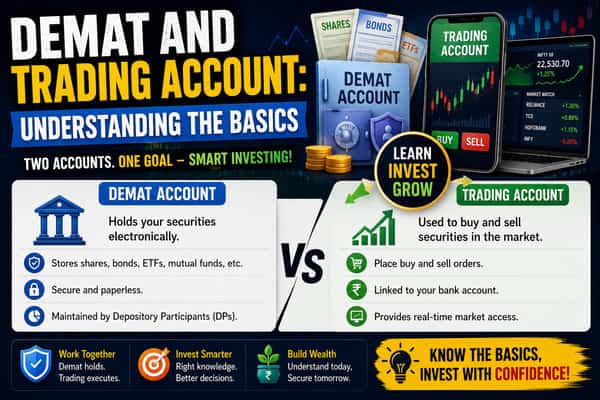
A Demat account — short for Dematerialised Account — is a secure electronic repository where your financial securities are stored in digital form. When you purchase shares of a company on the stock exchange, those shares must reside somewhere after the transaction is completed. That somewhere is your Demat account. It holds equities, bonds, ETFs, mutual fund units, government securities, and IPO allotments — all visible as digital entries under your unique account number.
Think of a Demat account as a secure digital locker or vault — it does not execute transactions itself, but it faithfully records and stores everything that results from transactions. It is passive in the act of trading but central to the outcome of every trade.
Demat accounts in India are regulated by SEBI and maintained through two central depositories — NSDL (National Securities Depository Limited) and CDSL (Central Depository Services Limited) — via Depository Participants such as banks and brokers.
What Is a Trading Account?
A Trading account is the operational platform through which you place buy and sell orders on Indian stock exchanges — the National Stock Exchange (NSE) and the Bombay Stock Exchange (BSE). It is the active instrument — the interface that allows you to submit trade instructions and have them executed on the exchange in real time.
Think of a Trading account as the marketplace interface — the tool you use to enter the market, place orders, monitor live prices, and execute transactions. Without a Trading account, you have no way to communicate your buy or sell intentions to the stock exchange.
Trading accounts are provided by SEBI-registered stockbrokers — full-service brokers like HDFC Securities, ICICI Direct, and Kotak Securities, or discount brokers like Zerodha, Groww, Angel One, and Upstox.
How Do They Work Together?
A Demat account and a Trading account work in a tightly coordinated sequence for every single stock market transaction — with a linked bank account completing the three-part financial infrastructure.
When you BUY shares: Your Trading account places the buy order on NSE/BSE → the order is executed → money is debited from your linked Bank account → shares are credited to your Demat account on T+1.
When you SELL shares: Your Trading account places the sell order on NSE/BSE → the order is executed → shares are debited from your Demat account → money is credited to your linked Bank account on T+1.
| Step | Buying Shares | Selling Shares |
| 1 | Place buy order via Trading account | Place sell order via Trading account |
| 2 | Order matched and executed on exchange | Order matched and executed on exchange |
| 3 | Money debited from Bank account | Shares debited from Demat account |
| 4 | Shares credited to Demat account (T+1) | Money credited to Bank account (T+1) |
This seamless three-account system ensures that money moves correctly, securities move correctly, and every transaction is recorded and settled with speed and accuracy.
Demat Account vs Trading Account: Core Differences
| Feature | Demat Account | Trading Account |
| Full Form | Dematerialised Account | No specific full form |
| Primary Purpose | Store and hold securities | Buy and sell securities |
| What It Contains | Shares, bonds, ETFs, mutual funds | Active orders, trade history |
| Who Regulates It | SEBI (via NSDL / CDSL) | SEBI (via stockbroker) |
| Who Provides It | Depository Participant (DP) | Stockbroker (NSE/BSE member) |
| Is It Mandatory? | Yes — to hold securities | Yes — to execute trades |
| Can It Work Alone? | Yes — can hold securities without active trading | No — trades must settle into a Demat |
| Nature | Passive — stores results of trades | Active — executes trade instructions |
| Settlement | Receives or delivers securities (T+1) | Triggers the settlement process |
| AMC Charges | Yes — Annual Maintenance Charge | Typically no AMC — brokerage on trades |
Can You Have One Without the Other?
This is one of the most frequently asked questions by beginners — and the answer is nuanced.
Can you have a Demat account without a Trading account? Yes — technically. If you received shares as a gift, an inheritance, or through a company ESOP scheme, you can hold them in a Demat account without actively trading through a Trading account. However, to ever buy or sell those securities on the open market, you will need a Trading account.
Can you have a Trading account without a Demat account? No — not for equity delivery trading. The purpose of a Trading account is to execute trades that result in securities being delivered — and that delivery requires a Demat account. However, for intraday trading (where positions are opened and closed within the same trading day with no actual delivery of shares), some brokers technically allow trading without Demat involvement, though this is not recommended for beginners.
In practice, virtually all brokers open both a Demat account and a Trading account simultaneously as part of a single account opening process — making the distinction largely invisible in the user’s day-to-day experience.
Key Features of Each Account
| Feature | Demat Account | Trading Account |
| Unique Identifier | DP ID + Client ID | Trading / Client Code |
| Holds | Securities (shares, bonds, ETFs) | Pending and historical orders |
| Settlement | T+1 credit or debit of securities | T+1 flow of funds |
| Portfolio Dashboard | Yes — full holding view | Order book and trade history |
| Corporate Actions | Auto-credits dividends, bonuses | Not applicable |
| Pledge Facility | Yes — securities as collateral | Not applicable |
| Nominee | Yes | Not applicable |
| Charges | AMC + DP transaction charges | Brokerage per trade |
How Are Both Accounts Opened?
In 2026, opening both a Demat account and a Trading account is a single, unified, fully digital process that takes 24 to 48 hours.
Step 1: Choose a SEBI-registered broker — full-service or discount. Step 2: Submit an online application with your personal details. Step 3: Upload KYC documents — PAN card, Aadhaar card, and bank details. Step 4: Complete Aadhaar OTP or video-based KYC. Step 5: E-sign the account agreement digitally. Step 6: Receive your Demat account number (DP ID + Client ID) and Trading account login credentials within 24 to 48 hours.
Both accounts are typically provided by the same broker and linked to the same PAN, bank account, and mobile number — creating a seamless single-login investment platform.
Frequently Asked Questions (FAQs)
Q1. What is the main difference between a Demat account and a Trading account?
A Demat account stores your securities electronically. A Trading account is used to place buy and sell orders on the stock exchange. One is a vault; the other is the marketplace interface.
Q2. Is it necessary to have both a Demat and Trading account?
Yes, for stock market investing. A Trading account alone cannot hold securities, and a Demat account alone cannot execute trades. Both are needed together for complete stock market participation.
Q3. Do I need separate accounts with different providers?
No. Most brokers provide both a Demat account and a Trading account simultaneously under one platform. You can open, manage, and use both through a single login.
Q4. Which account charges brokerage fees?
Brokerage fees are charged by your Trading account provider — levied as a flat fee or percentage on each buy or sell transaction. Demat accounts charge AMC and DP transaction fees.
Q5. Can I transfer shares from one Demat account to another?
Yes. Shares can be transferred between Demat accounts using the DIS (Delivery Instruction Slip) process or the CDSL/NSDL online transfer facility — useful when switching brokers.